- Doc no.
- BD-101
- Program
- Ground Truth
- Class
- Android / GNSS
- Phase
- 1.5
Ground Truth
A survey instrument that happens to be a phone.
Overview
Sec. 1 — General descriptionGround Truth turns an Android phone into a survey-grade GPS tool. Stand at a point, let it collect GNSS samples for a few minutes, and it produces the most accurate position the phone's hardware can deliver — along with an honest estimate of how accurate that actually is, rather than false precision.
It is built for surveyors, land professionals, GIS and mapping hobbyists, and anyone who wants better-than-consumer-GPS accuracy without buying dedicated survey hardware.
Capabilities
Sec. 2 — Functional specification- Surveys a fixed point by sampling until the estimate converges to a target accuracy — with auto-complete, timeout, and manual accept.
- Reports real statistical uncertainty: a confidence ellipse, not a flattering number.
- Shows coordinates in WGS84 decimal and DMS, UTM, and custom projections, with both ellipsoidal and sea-level height.
- Exports CSV, GeoJSON, GPX, and RINEX for professional post-processing services.
- Built-in GNSS diagnostics: sky plot, per-satellite signal strength, and constellation breakdown — so you know what your hardware can actually do.
- Captures survive a locked screen; a session runs to completion in the background.
Planned: live RTK correction services and external Bluetooth receivers for centimeter-level work.
Field views
Sec. 3 — Figures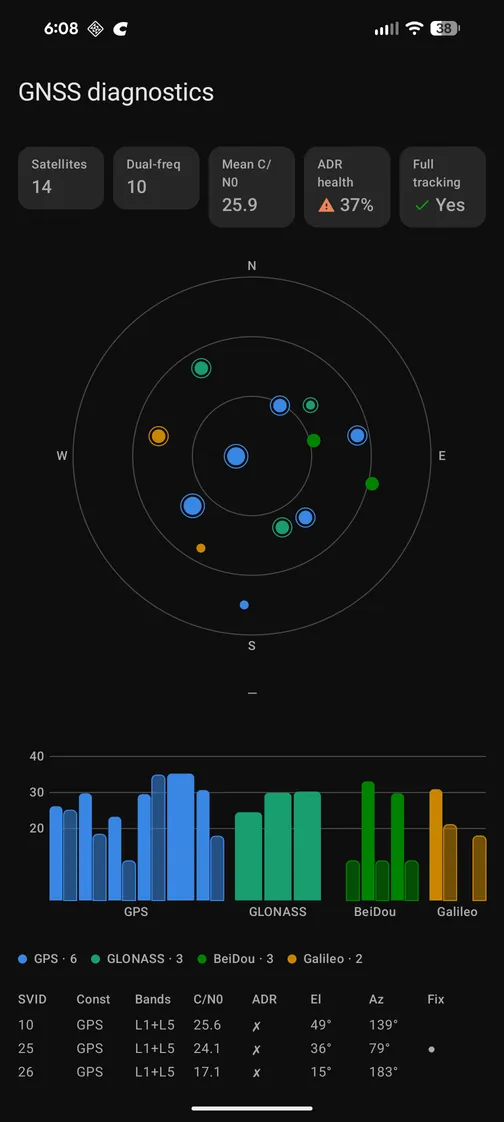

Requirements & status
Sec. 4 — DeploymentRequires a dual-frequency GNSS chipset and Android 14 or newer — developed against the Pixel 8 Pro. Lesser hardware degrades gracefully, with warnings instead of wishful numbers.
Core capture, filtering, exports, and diagnostics are complete and in field testing. Current work is an interface overhaul driven by that testing. Not yet published; documentation forthcoming.